
 Image 1 of 2
 Image 2 of 2
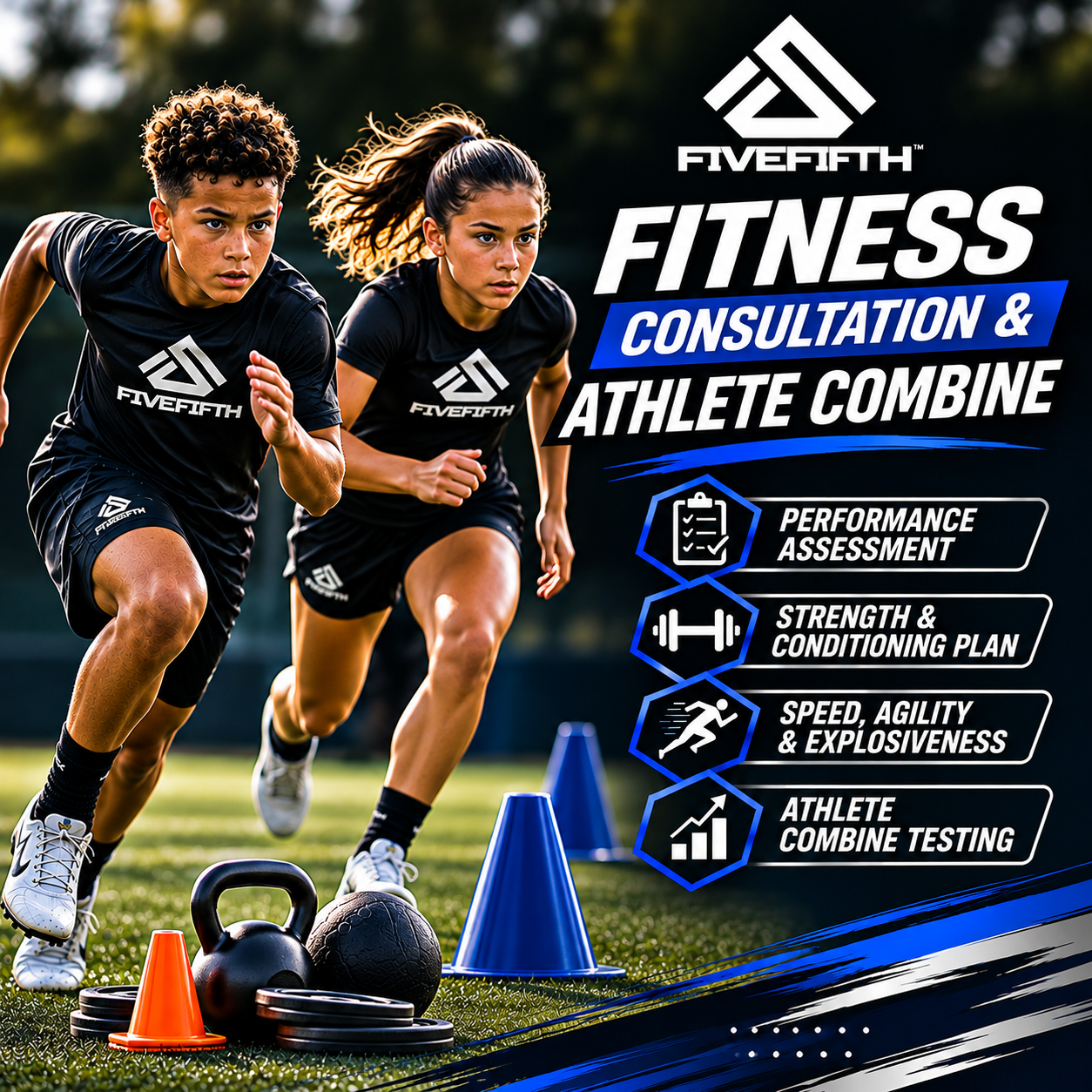
Fitness Consultation & Athlete Combine
Fitness Consultation & Athlete Combine
College and pro scouts rely on the combine to see exactly what an athlete can do. Now your child gets the same experience. The FiveFifth Fitness Consultation & Athlete Combine gives you a complete, honest picture of where your athlete stands today and a clear roadmap for where they can go.
It starts with a consultation. Michone sits down with you and your athlete to discuss their sport, position, goals, training history, schedule, and any past injuries or concerns. This conversation helps us understand what matters most to your athlete and what to focus on during testing.
Next, we schedule an in-person combine session. Your athlete is put through a series of performance tests measuring speed, acceleration, agility, change of direction, strength, power, stamina, balance, coordination, and flexibility. Every test is age-appropriate, professionally coached, and designed to be challenging, fun, and confidence-building.
After the combine, your athlete receives a full athlete worksheet, a personal performance profile that includes their baseline numbers for every test, a breakdown of their strengths and the areas with the most room for growth, recommended training focuses and drills, and a roadmap they can follow and retest against over time.
The worksheet is built to last. Athletes can use it for years, returning to test again each season and see their progress in real numbers. It’s a powerful tool for motivation, goal setting, and showing coaches exactly how hard an athlete has worked.
The more you know, the more you can control and work on. Instead of guessing what to improve, your athlete trains with purpose, focusing on the things that will make the biggest difference on game day. It’s the beginning of success, on and off the field.
Here are the standard combine drills, grouped by what they measure, plus youth-friendly notes so you can use them in your FiveFifth Athlete Combine.
Combine examples:
Speed
40-Yard Dash: The classic sprint test. Measures straight-line top speed. For younger kids, a 20- or 30-yard dash works well.
10-Yard Split: Timed within the 40. Measures acceleration and first-step explosiveness, which matters most in nearly every sport.
Flying 20: Athlete gets a running start, and only the last 20 yards are timed. Measures pure top-end speed.
Agility & Change of Direction
Pro Agility Shuttle (5-10-5): Athlete sprints 5 yards, back 10, then 5 more. Measures lateral quickness and cutting ability.
3-Cone Drill (L-Drill): Three cones in an L shape. Measures agility, body control, and bending around corners.
T-Test: Forward sprint, shuffle left, shuffle right, backpedal. Great for soccer and basketball since it combines all movement directions.
60-Yard Shuttle: Sprints of 5, 10, and 15 yards and back. Measures agility plus short-burst endurance.
Power & Explosiveness
Vertical Jump: Standing jump for height. Measures lower-body explosive power.
Broad Jump (Standing Long Jump): Jump forward from a standstill. Measures horizontal power, which ties closely to sprint speed.
Medicine Ball Throw: Seated chest pass or overhead throw for distance. Measures upper-body and core power.
Strength
Bench Press Reps (225 lbs at the NFL level): Not appropriate for youth. Swap in max push-ups in 60 seconds or until form breaks.
Pull-Ups or Flexed-Arm Hang: Measures upper-body pulling strength.
Plank Hold: Measures core strength and stability.
Wall Sit: Measures lower-body muscular endurance.
Stamina & Conditioning
Beep Test (PACER Test): Back-and-forth 20-meter runs that get faster with each level. The gold standard for youth endurance testing.
Yo-Yo Intermittent Recovery Test: Similar to the beep test with short rest breaks. Popular in soccer because it mimics game demands.
Mile Run or 300-Yard Shuttle: Simple timed endurance tests.
Balance, Coordination & Flexibility
Sit-and-Reach: Measures hamstring and lower-back flexibility.
Single-Leg Balance: Timed hold on each leg, eyes open and closed. Flags imbalances that can lead to injury.
Reaction Drill: Athlete reacts to a coach’s signal, ball drop, or light. Measures reaction time.